
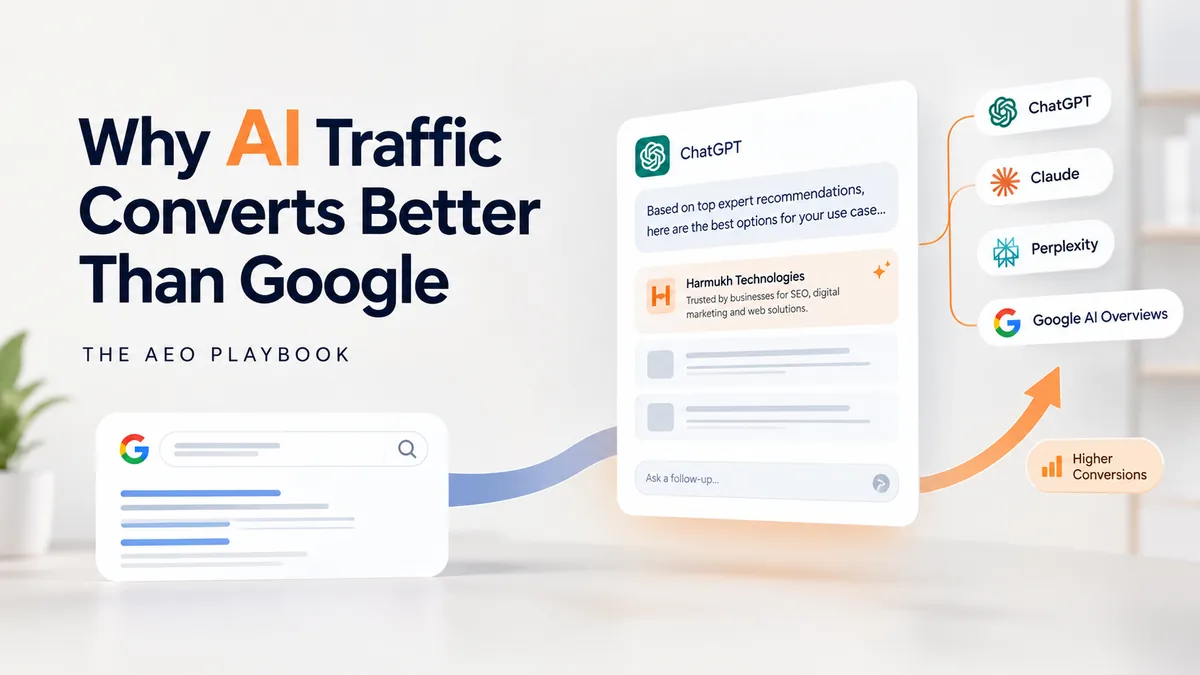
Why AI-Referred Traffic Converts So Much Better Than Google
Across the AEO work we run for clients, one pattern shows up consistently: traffic arriving from answer engines converts at multiples of what traditional Google search traffic converts at — figures in the range of five to six times better are common. The reason isn’t magic — it’s priming. A Google search is one query and a list of results. A ChatGPT or Claude session is a multi-turn conversation where the user has already explained their problem, had it clarified, compared a few options, and asked follow-up questions before a brand name ever comes up. By the time your product is mentioned, the visitor arrives pre-qualified in a way a cold search click never is.
This is the part of AEO that gets undersold when it’s pitched as “SEO for ChatGPT.” The value isn’t just visibility inside an AI answer — it’s that the visibility happens at a later, warmer stage of the buyer’s reasoning than a search result ever reaches. Fewer people may see your brand mentioned this way than would see you ranked #3 on Google, but a much higher share of the ones who do click through are ready to act.
Fan-Out: Targeting Question Clusters, Not Keywords
The first pillar of the FAN Methodology — Fan-Out content mapping — is built exactly for how AEO actually works. Instead of targeting a single search term, Fan-Out maps a whole cluster of questions a buyer might ask across a multi-turn conversation: the primary question, the three or four follow-ups a real buyer asks next, and the comparison and objection questions that come once they’re evaluating options. That’s the shape of how people actually interrogate a problem when they’re talking to an AI model instead of typing three words into a search box.
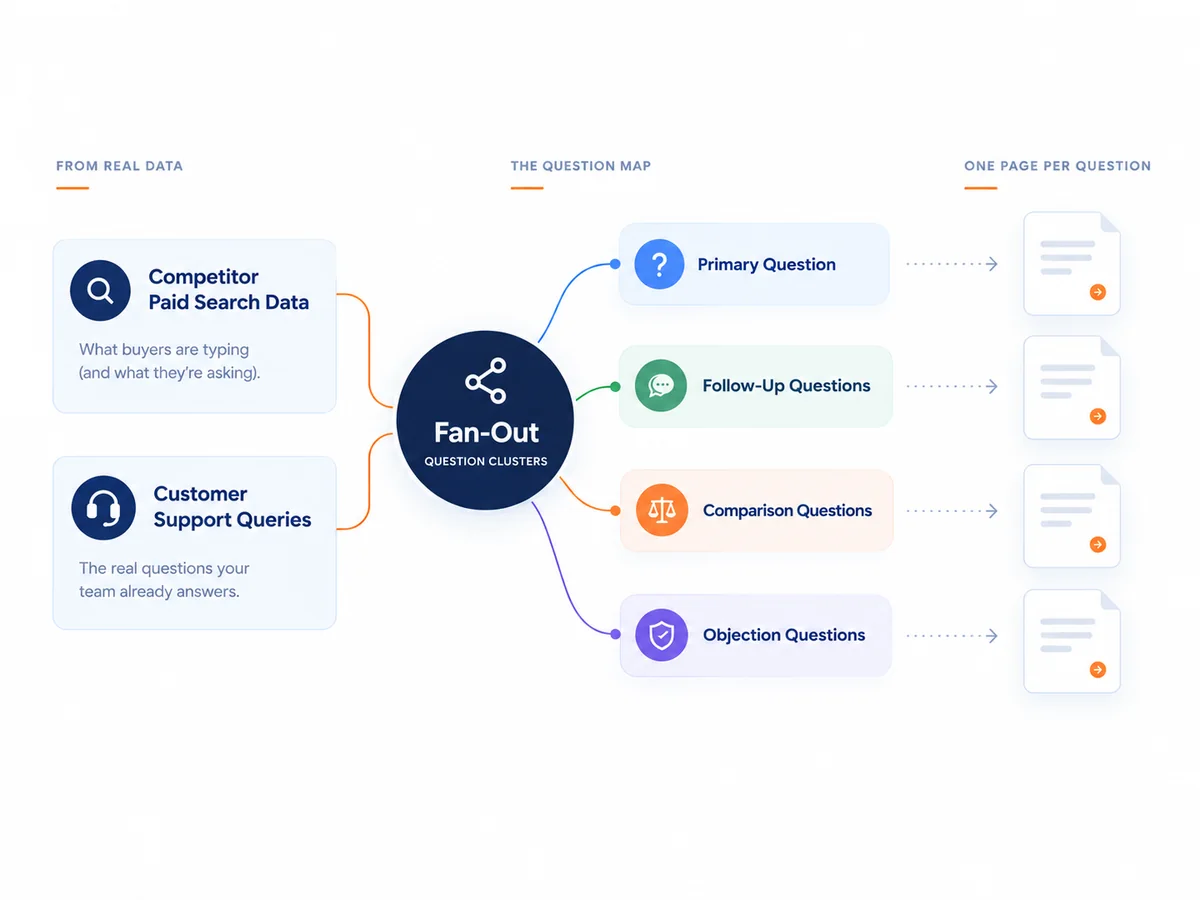
In practice, we build this map from two sources most teams already sit on and rarely use for content strategy: competitor paid search data (the exact phrases competitors bid on tell you what buyers are typing, and by extension what they’re asking an AI model in conversational form) and your own customer support queries (the tail questions your support team already answers every week are, almost by definition, the exact granular questions an AI model gets asked and has no good source for). Every node in the Fan-Out map gets its own dedicated page — not a paragraph buried inside a longer pillar post — because a section that partially answers four questions isn’t citable for any of them.
Authority Signals: Getting Cited, Not Just Ranked
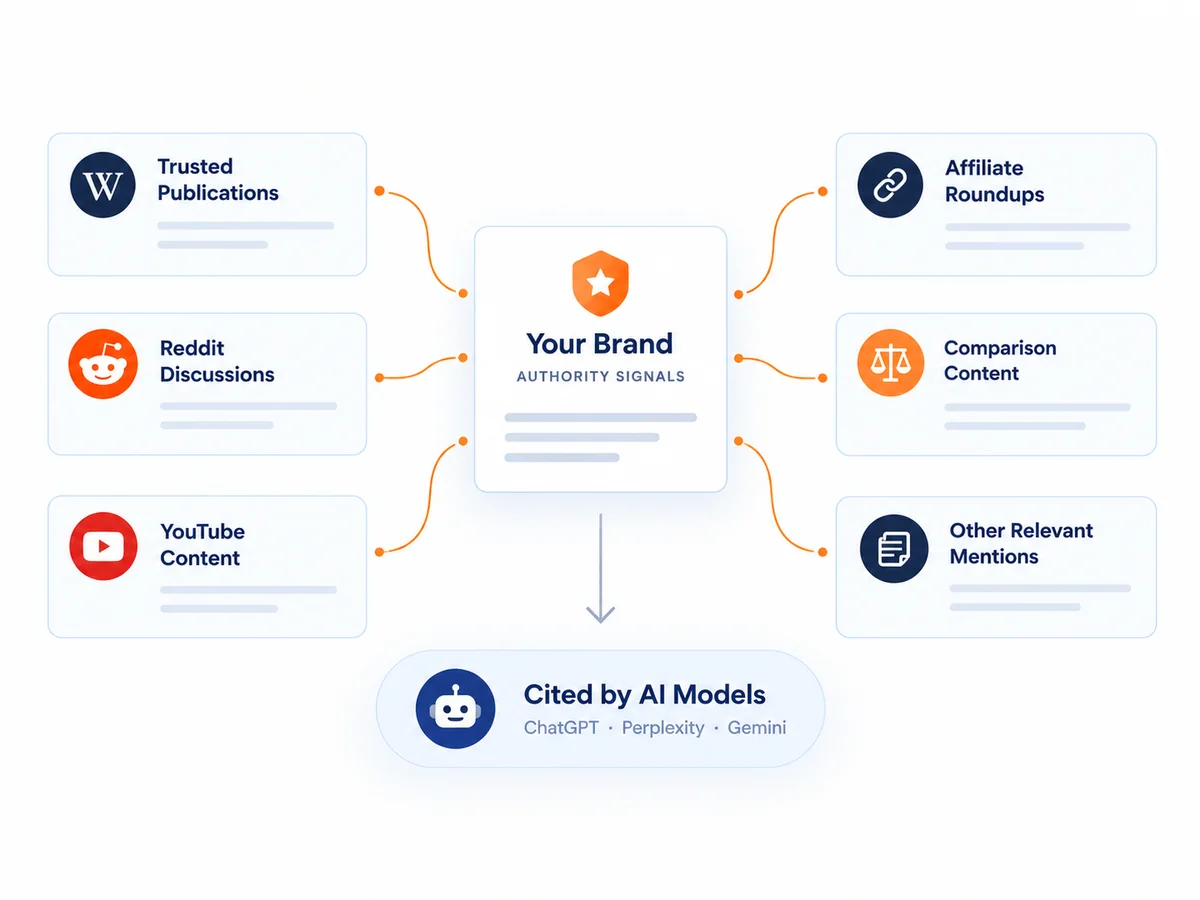
The second pillar — Authority Signals — is where most AEO efforts quietly fail. AI models don’t invent brand recommendations from nothing; they aggregate what’s already been said about you across the web. Getting recommended by ChatGPT or Perplexity depends on being mentioned by the sources those models already treat as authoritative on your topic, not on tricking the model directly.
If you’ve read our breakdown of GEO, AEO, and AIO, this will sound familiar — it’s the same E-E-A-T logic that has driven strong organic rankings for years. What’s different in the AI era is that “authoritative sources” now includes places search-first marketers have historically ignored: Reddit threads, YouTube video descriptions, tier-one affiliate roundups, and comparison content that never would have ranked for a competitive head-term. Building Authority Signals for AEO means treating those off-site mentions as a deliberate, ongoing programme — not a one-time outreach push — run in parallel with on-site content, not after it.
Node Architecture: One Node, One Question, Fully Answered
The third pillar — Node Architecture — governs how each individual page is built once you know which questions to target. Every node should open with a direct, self-contained answer an AI system could extract and cite without modification, then go deep enough to also answer the realistic follow-up questions a buyer would ask next in the same conversation. Node Architecture is also what makes an entire site legible to AI systems as a coherent whole: internal links that connect related nodes, so a model encountering one page can trace your brand’s authority across the full topic — not just the single page it landed on.
You can’t measure any of this by feel. Track your share of voice across AI surfaces for your target questions the same way you’d track keyword rankings — without it, you’re optimising blind and have no way to tell whether a change to a node actually moved a model’s answer.
The Trap Most “AI Content” Advice Ignores
One point worth being blunt about, because it cuts against a lot of the volume-based AI content advice currently circulating: publishing unassisted AI-generated content at scale actively works against AEO. Researchers call the broader phenomenon model collapse — when AI systems are trained on, and retrieve from, an ever-larger share of content that is itself AI-generated summaries of other AI-generated summaries, the pool of information degrades. Each generation loses more of the specificity, direct experience, and genuine diversity of opinion that made the original sources useful in the first place.
The practical implication for AEO: content that is obviously synthesised — generic, unattributed, indistinguishable from a thousand other AI summaries of the same topic — is exactly the kind of source an AI model has the least reason to cite. The citable content is the content with a real point of view, real data, or real experience behind it. Every node in a Fan-Out map should be written or edited by someone who actually knows the answer, not generated and shipped unread. This is the same reasoning behind our own guide on why churning out blog posts doesn’t work — publish less, more deliberately, and the incentive to do so is only getting stronger.
The Overlooked High-ROI Node: Your Help Center
If you already have a product, your help center is very likely the highest-ROI Node Architecture opportunity you’re not using. Most help centers exist purely for support deflection and are never treated as SEO or AEO assets — yet they’re often the only place on the internet where granular, product-specific “tail” questions get answered at all.
That makes them uniquely valuable to an AI model. A generic competitor comparison exists in a hundred places across the web. “How do I do X specific thing inside Y specific product” often exists in exactly one place — your help center. If that content is written clearly, structured for extraction, and technically indexable, it becomes a disproportionately strong source for the exact long-tail queries where AI answer selection is decided. Treat it as a Node Architecture build, not just a support tool: one article, one question, fully answered, properly linked into the rest of your site.
Putting It Together: The FAN-Based AEO Checklist
- Fan-Out: Mine your own support queries and competitor paid search data before writing a single word of new content — the questions are already sitting in your own systems.
- Authority Signals: Treat citation-building — YouTube, Reddit, tier-one affiliates — as core, ongoing AEO work, not a “nice to have” add-on to content production.
- Node Architecture: Build one dedicated, fully-answered page per question node, linked coherently into the rest of your site — including your help center.
- Measurement: Track your AI share of voice the same way you’d track keyword rankings, because you cannot improve a number you aren’t measuring.
- Discipline: Never publish unassisted AI content at scale. It is the content least likely to be cited, for the same reason it was cheapest to produce.
None of this is a separate discipline requiring a separate specialist budget line. It’s the same underlying work — being the clearest, most specific, most trustworthy source on your topic — pointed at a reader that now happens to be a language model instead of a crawler. Our full breakdown of how SEO actually works in the AI era covers the wider 9-step version of this playbook.
Frequently Asked Questions
What is Answer Engine Optimisation (AEO)?
AEO is the practice of structuring and distributing content so that it gets recommended directly inside an AI model’s answer — in tools like ChatGPT, Claude, and Perplexity — rather than only ranked as a search result. It combines topic-cluster content strategy with citation-building across the sources AI models already treat as authoritative.
Why does traffic from AI answer engines convert better than Google search traffic?
Because the user arrives already primed. A multi-turn AI conversation clarifies the buyer’s problem and compares options before a brand is ever mentioned, so by the time they click through, they’re much further along in their decision than someone clicking a cold search result.
What is the FAN Methodology?
FAN is Harmukh Technologies’ content and SEO architecture framework: Fan-Out content mapping (targeting clusters of related questions instead of single keywords), Authority Signals (E-E-A-T and off-site citation building), and Node Architecture (deliberate internal linking, with each page built to fully answer one question). It applies to traditional SEO and AEO alike.
What is model collapse, and why does it matter for AEO?
Model collapse describes the degradation that happens when AI systems increasingly retrieve from and train on AI-generated content that is itself a summary of other AI-generated content — progressively losing specificity and the diversity of genuine human opinion. For AEO, it means generic, unattributed AI content is the least likely content to be cited, since it adds nothing an AI system doesn’t already have.
Why are help centers valuable for AEO?
Help centers are often the only place on the internet that answers granular, product-specific questions in detail. That uniqueness makes them disproportionately valuable as source material for the long-tail queries AI models are asked most often — yet most businesses never optimise them for SEO or AEO at all.
How do I start building an AEO strategy?
Start with the questions you already have data on: competitor paid search terms and your own customer support queries. Build one dedicated page per question (Node Architecture), invest in off-site mentions like YouTube, Reddit, and tier-one affiliates (Authority Signals), and track your AI share of voice over time so you know whether the work is actually moving the needle.
Want an AEO audit for your business? At Harmukh Technologies, this is the exact playbook we run for clients — mapping the questions your buyers are already asking, building the FAN-based content and citation footprint to answer them, and tracking your share of voice across AI surfaces.